For a growing share of the capital that funds housing in South Africa, ESG is no longer a section at the back of the annual report. It is a condition precedent: a set of tests a development has to pass before the money moves, and a set of numbers the lender expects to keep receiving afterwards.
That shift is awkward for construction, because conventional site building is close to the hardest place in the economy to evidence anything. Work is performed outdoors, by a chain of subcontractors, under conditions that change hour to hour, with materials measured by allowance and waste removed by skip. A scheme built that way can be genuinely well run and still be unable to produce a defensible number for what it emitted, wasted, or paid whom.
The argument is about measurability, not virtue
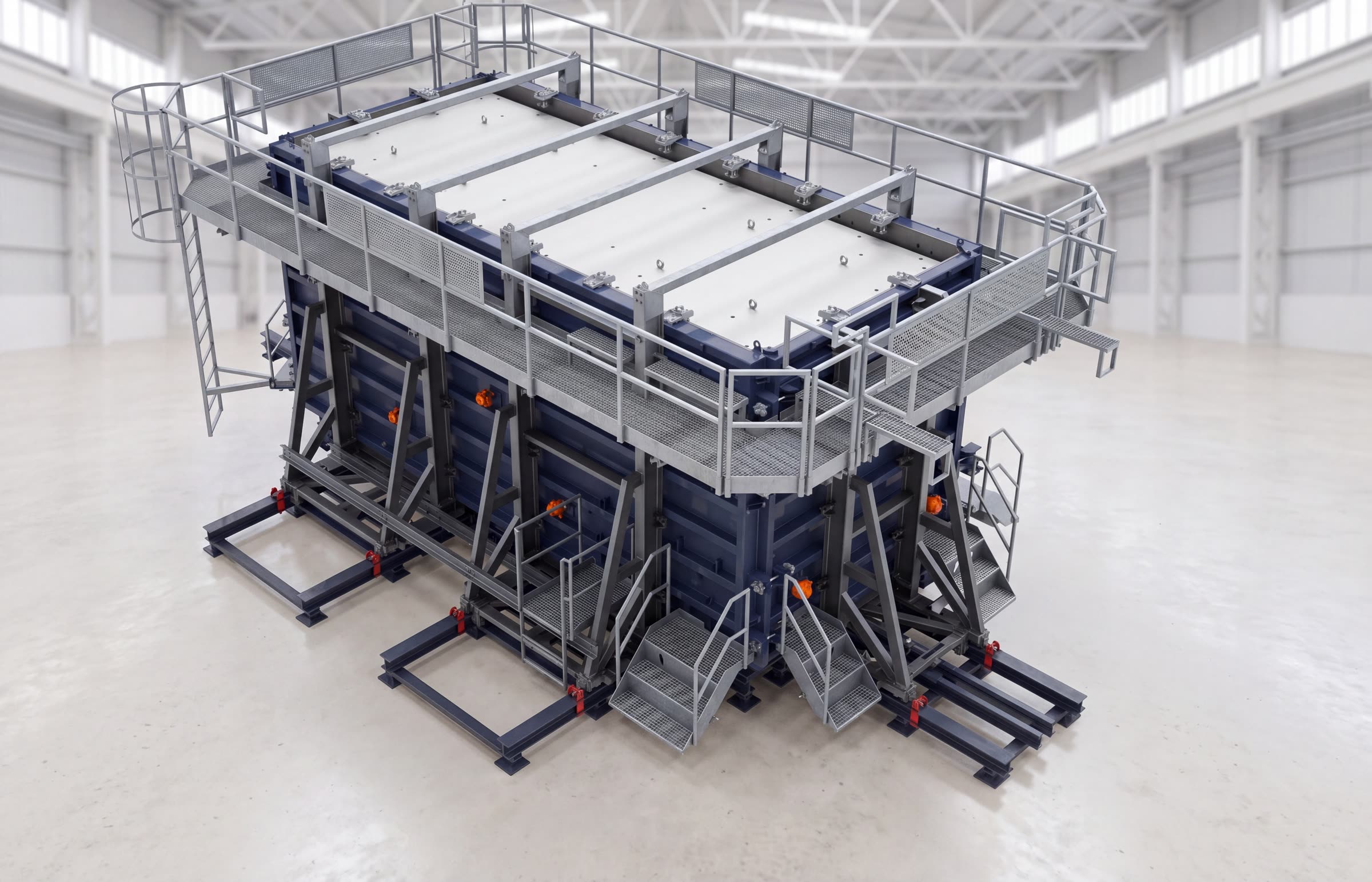
Moving nine tenths of the work into a factory does reduce environmental impact, and we set out how on the sustainability pages. But the more durable ESG argument is structural rather than numerical: a factory is an environment where the inputs are batched, the outputs are counted, the process is the same every cycle, and one organisation is accountable for all of it.
That is the same property that makes industrialised construction programme-certain. A repeatable process is measurable almost by definition — and a measurable process is one whose ESG claims can be audited rather than asserted.
The ESG advantage of a factory is not simply that it wastes less. It is that it can show what it did, cycle by cycle.
The three letters, in a production environment
What changes under each heading when a building is manufactured rather than assembled in the open.
- E
Environmental
Material quantities are known before the pour, offcuts are recovered rather than skipped, and formwork is permanent steel tooling instead of timber consumed job by job. Up to 90% less construction waste than traditional methods, and a 50+ year design life that pushes replacement far beyond the usual horizon.
- S
Social
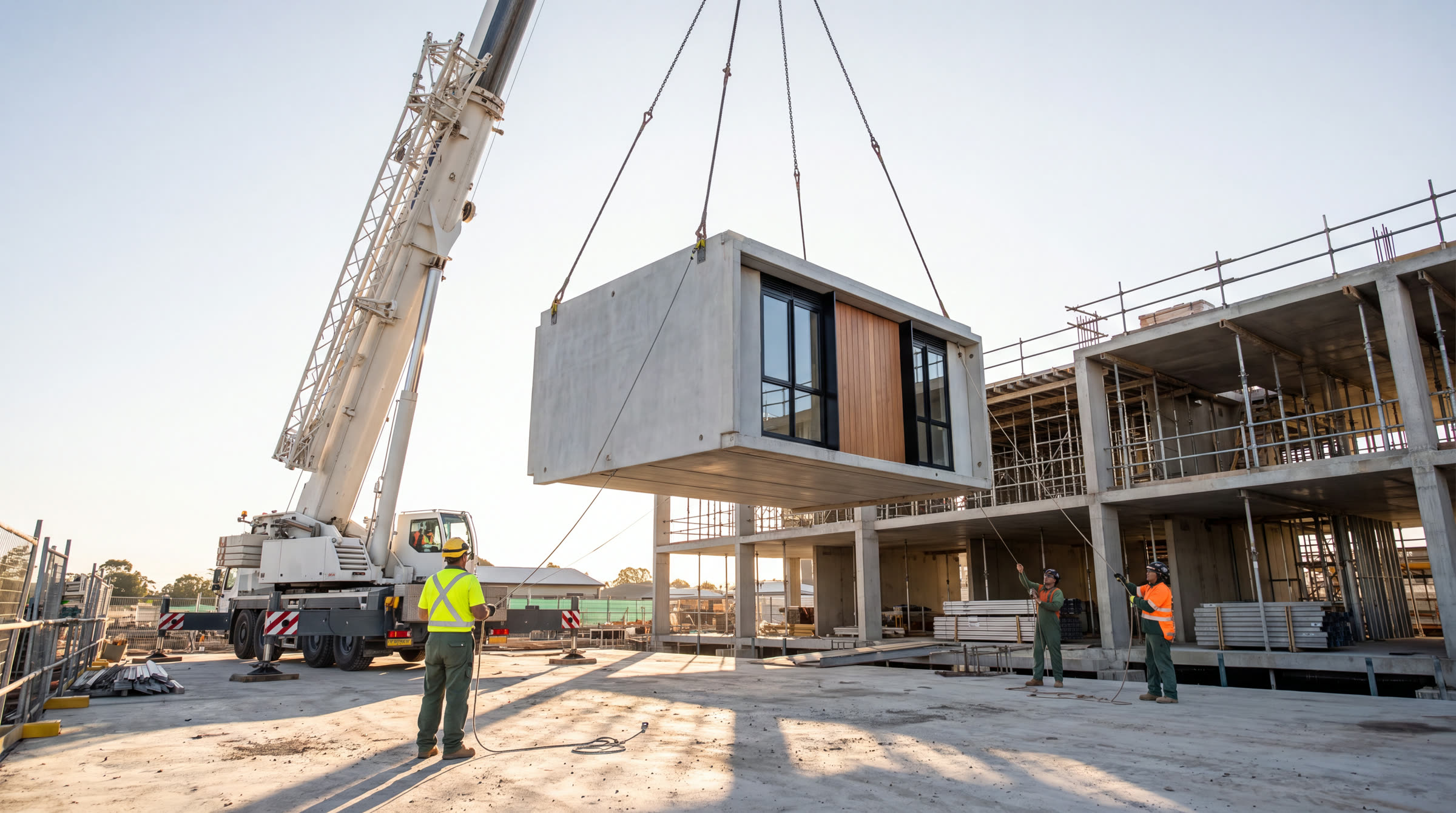
Production, quality assurance and logistics create local jobs that are indoors, year-round and teachable — a different proposition from itinerant site labour. Faster delivery also puts occupiable housing against the backlog sooner, and neighbours next to the site experience placement rather than construction.
- G
Governance
One accountable party carries design, manufacture, delivery and installation, so there is no subcontractor chain to lose the audit trail in. Quality, safety and environmental indicators are tracked per module against a fixed production cycle rather than reconstructed from site records afterwards.
Environmental — reported per module, not per project
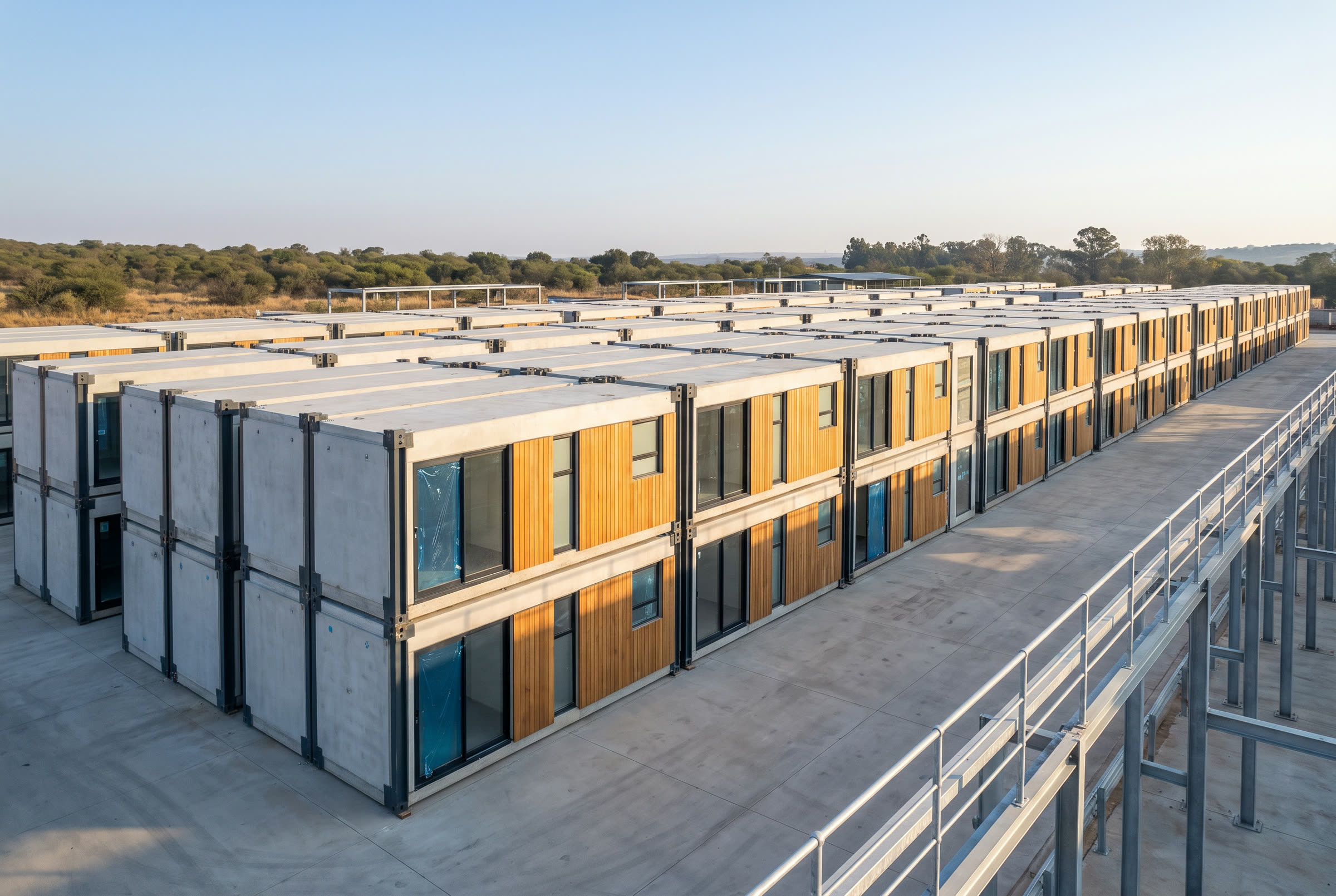
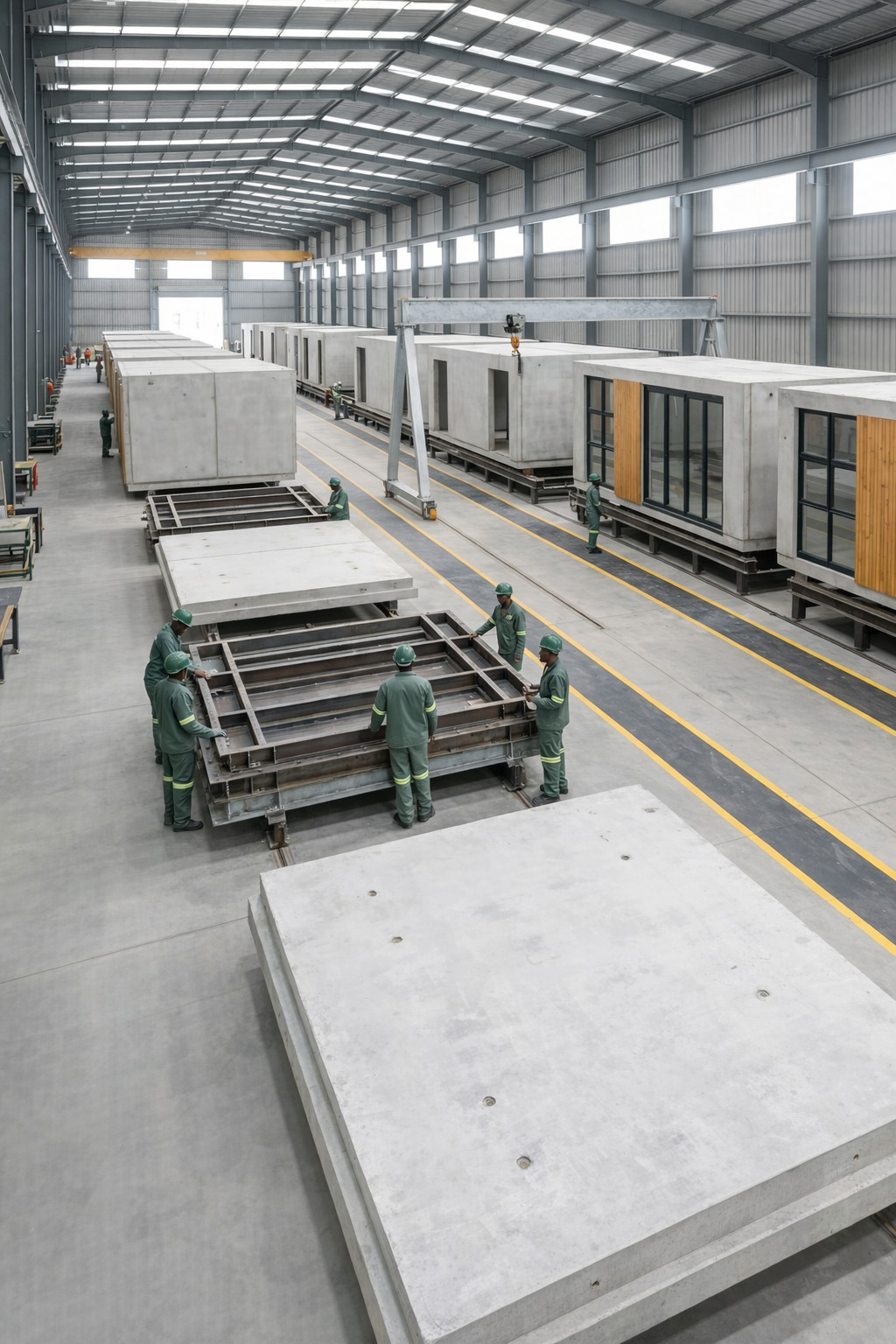
The useful unit for an industrialised process is the module, not the scheme. Because every module goes through the same six operations, embodied carbon, cement content, water and energy can be attributed to a single repeatable object and then multiplied — rather than estimated across a project whose conditions never repeated.
That is also what makes improvement legible. Lower-carbon mix design, cement replacement with supplementary cementitious materials, recycled aggregate in non-critical applications: each is a change to a known baseline with a measured effect, instead of a policy statement. The same logic covers the quieter environmental gains — fewer material loads to move, far less to landfill, and a site that is disturbed for weeks rather than seasons.
Social — the work moves indoors, and it becomes teachable
The social dimension of industrialised construction is usually misread as a threat to employment. In practice the labour does not disappear; it relocates and changes character. Casting, finishing, quality assurance, dispatch and installation are year-round roles performed under a roof, in fixed conditions, on a fixed cycle — which makes them trainable in a way that a rotating site workforce is not.
Health and safety follows the same logic. A factory floor with defined operations and permanent handling equipment carries a materially different risk profile from working at height, in weather, on a surface that changes every week. And the fastest social return of all is simply the building: a scheme that completes sooner houses people sooner, which for a public programme or a student intake is the entire point.

Governance — a single accountable party is an ESG feature
Most governance failures in construction are interface failures. Responsibility for an outcome sits between two contracts, the record of who decided what is incomplete, and by the time a question is asked the people who could answer it have demobilised. The more parties in the chain, the more places the audit trail can break.
Carrying design for manufacture, casting, fit-out, logistics, installation and commissioning under one accountable platform is usually presented as a delivery advantage. It is equally a governance one. There is one quality regime rather than several, one set of records, one party answerable for the environmental and safety indicators — and approval gates that close each stage before the next begins, so decisions are documented at the point they are made.
What the system is built to
- Structural design
- Eurocode
- Engineering basis for the module and its connections
- National standards
- SABS
- South African compliance route for the delivered building
- Quality system
- ISO 9001
- Held by the European equipment supplier; Precast Africa certification follows plant commissioning
- Green building
- GBCSA
- Rating framework the developments are designed against
- Off-site
- 60–90%
- Of construction completed in controlled conditions
- Waste
- 90%
- Up to 90% less construction waste vs. traditional methods
- Design life
- 50+ yr
- Engineered, low-maintenance concrete
What we can evidence today, and what we cannot
An article about auditable claims should be careful about its own. Precast Africa has no delivered scheme, so there is no measured operating record to publish — no realised carbon figure, no waste return, no safety history. Anything presented as one would not survive technical due diligence, and we would rather say so here than be found out later.
What exists today is the design of the measurement. The indicators are defined — embodied carbon and cement replacement per module, waste, water and energy per module, local supplier participation, defect rate at handover, safety incidents — and they are tracked from the first production run rather than introduced once there is something flattering to report. The system specifications above are source-stated by the equipment manufacturer. The performance of the company against them is a future record, and it will be published as one.
For a funder applying an ESG test, that distinction is the point. The question worth asking of any construction counterparty is not what they claim to have achieved, but whether their process is capable of producing an honest answer at all.
System specifications are source-stated in the equipment manufacturer’s specification, July 2026; standards and rating frameworks describe the compliance route the developments are designed against, not certifications already held by Precast Africa. Precast Africa has no delivered scheme, and no operating ESG performance data is claimed. All performance claims remain subject to approved engineering and product-specific certification.